
Table of Contents
Introduction
Effective working together depends on an open approach and honest relationships between agencies. Problem solving and resolution is an integral part of professional co-operation and joint working to safeguard children and young people.
Transparency, openness and a willingness to understand and respect individual and agency views are a core aspect of multi-agency / inter-agency working. However, there may be occasions where individuals / agencies working with children and families disagree on how best to keep children safe and promote their welfare.
Disagreements can arise in a number of areas, but are most likely to arise around:
- Perceived levels of risk
- Levels of need and whether a child has met the threshold for a service or intervention
- Roles and responsibilities
- Level or quality of communication/ information sharing
- Provision of services
- Action or lack of action progressing plans
- Cases being / not being stepped up or down and / or closed
The Cambridgeshire & Peterborough Delegated Safeguarding Partners are clear that there must be respectful challenge whenever there is a professional disagreement. The aim must be to resolve a professional disagreement at the earliest possible stage, always keeping in mind that the child and young person’s safety and welfare is paramount.
If a child is thought to be at immediate risk of harm, the designated safeguarding lead in your agency should be informed immediately.
Any worker who has concerns around a professional disagreement should consult their supervisor / manager to clarify their thinking and for advice and supervisory support. They should be able to evidence the nature and source of the concerns and should keep a record of all discussions.
Concerns relating to decisions, suspected wrongdoing or dangers at work within an agency, should be raised in line with each agency’s policies for dealing with such matters, including, but not limited to, those setting out the arrangements for ‘whistleblowing’.
Where a dispute involves a complaint about the behaviour or professional conduct of a worker, this should be reported initially to their line manager to action under agency policy. For allegations against staff, the agency’s whistleblowing / complaints procedure should be used and a referral to the LADO (Local Authority Designated Officer) should be considered / made (child protection concern).
Key Principles
- The child’s safety and welfare should be the key focus at all times and any dispute between individuals / agencies should never leave a child unprotected
- It is the responsibility of all professionals to be assertive and to present a respectful challenge to the actions and decisions of other agencies where they believe there is evidence to suggest that the child’s safety or development may be compromised
- A culture of professional challenge can be developed and facilitated through consistent communication and information sharing between agencies and within clear plans for children and families. Professionals should know who in the multi-agency network is involved with the child, young person and their family
- Individuals /agencies should not be defensive when challenged and must always be prepared to review decisions and plans with an open mind and revise decisions in light of any new information
- Differences of opinion should be resolved at the earliest stage and within the shortest timescale possible to ensure that the child is placed at the centre of decisions to achieve best outcomes and for support to be sought and put into place at the earliest opportunity.
Examples, where the concerns about the child should prompt action, are given below. This list is not exhaustive.
- Dispute at the point of referral made by one agency to another due to differing opinions about thresholds/eligibility for services,
- Concern about the action / inaction of another professional in relation to a child or family member or non-compliance with safeguarding procedures/statutory guidance,
- Professional difference about decision making and a course of action to be taken, for example whether there should be a Child Protection Case Conference or, whether a case should be closed including step up – step down,
- Professional difference about the outcome of a Child Protection Conference which had been raised during the Conference and is recorded in the record of the meeting. (NB Family members will use the Council’s complaints process if they disagree with the outcome of a Child Protection Conference),
- Professional difference about the implementation of a child’s plan or its effectiveness in bringing about the necessary changes, including drift or absence of multi-agency meetings,
- Professional difference about information sharing,
- Difference of professional opinion over the outcome of an assessment and/or differences about the analysis of information and associated decision making,
- Professional difference about the provision of services,
- Concern that the child’s lived experiences are not informing assessment, decision making or planning,
- Concern that there is drift or unreasonable delay in progressing a case,
- Concerns about the operation of child protection procedures.
NOTE: If a child is thought to be at imminent risk of harm, the matter should be referred immediately to the Police/ Children’s Services to decide what action to take to safeguard/protect the child whilst the dispute is being resolved.
Resolving Differences of Opinion; Stages of Resolution
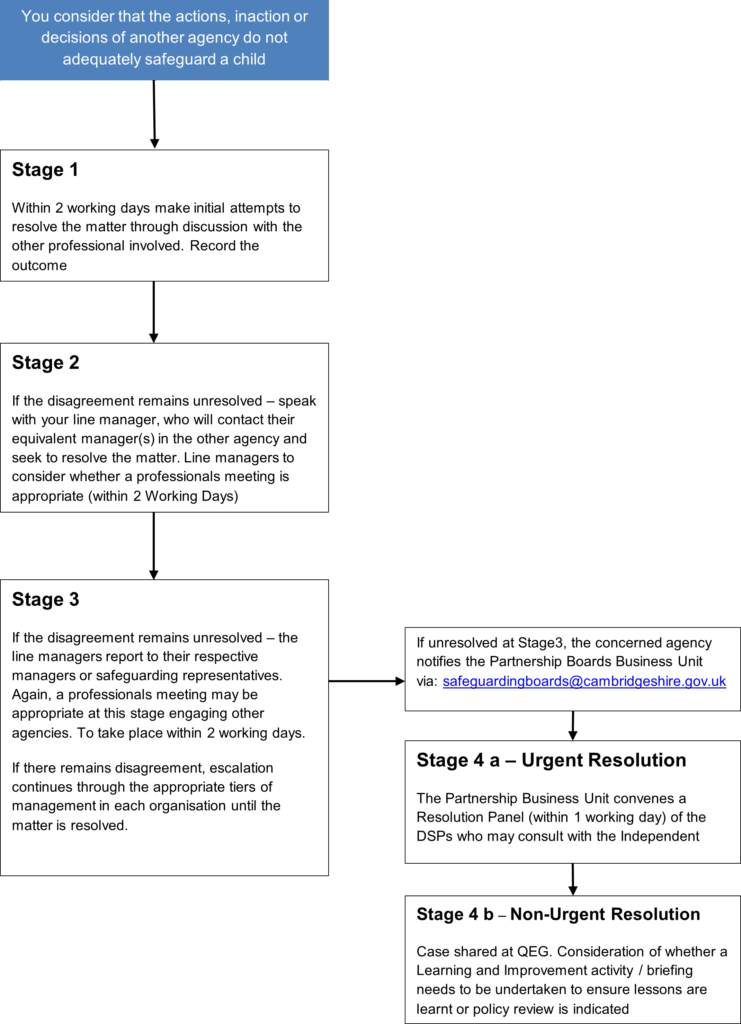
Stage One: Discussion between workers
The people who disagree should have a discussion to try to resolve the problem. This discussion must take place as soon as possible and could be a telephone conversation or a face-to-face meeting. It should be recognised that differences in status and /or experience may affect the confidence of some workers to pursue this unsupported. The discussion should be recorded in the child and family’s records and a mutually agreed plan of action developed.
Records should include the concern, action(s) taken to resolve, agreed actions from resolution process, timescales and the outcome. This should be clear, evidenced and factual.
Stage Two: Discussion between Line Managers
If the problem is not resolved and concerns remain, the worker should contact their supervisor / line manager / safeguarding lead within their own agency to consider the issue raised, what outcome they would like to achieve and how differences can be addressed.
The line manager should contact their respective counterpart(s) to try to negotiate an agreed way forward. This could involve a professionals meeting if deemed appropriate. The discussion should be recorded in the child and family’s records and a mutually agreed plan of action developed. Records should include the concern, action(s) taken to resolve, agreed actions from resolution process, timescales and the outcome. This should be clear, evidenced and factual.
Stage Three: Discussion between Operational/Senior Managers
If the issue is not resolved at stage two, the supervisor/ line manager reports to their manager or named/ lead safeguarding representative. Those senior managers must liaise and attempt to resolve the professional differences through discussion. The discussion should be recorded in the child and family’s records and a mutually agreed plan of action developed. Records should include the concern, action(s) taken to resolve, agreed actions from resolution process, timescales and the outcome. This should be clear, evidenced and factual.
Stage Four : Resolution by Delegated Safeguarding Partners (DSPs)
- Urgent resolution required – Resolution Panel Meeting
If there is no resolution, and having exhausted all other routes, the matter should be escalated to the Partnership Board Business Unit. A Resolution Panel Meeting will be convened by the Partnership Board Business Unit with the delegated safeguarding partners and the senior leader/managers from those agencies involved, if either party are not one of the statutory agencies. The meeting will be a forum where the agencies can discuss the case and conflict issue in a chaired and minuted meeting, with resolution being agreed and recorded. The DSPs may wish to draw upon the advice and guidance of the Independent Scrutineer as part of this stage. - Non-urgent and / or lessons learned
Operational/senior managers can advise that the learning points from a non-urgent case should be referred to the Quality Effectiveness Group for interagency consideration. At this point the group may make recommendations for individual agencies to review performance and/or involvement, or for safeguarding partnership boards policy and procedural review and development.
Appendix 1 – Escalation Procedure and Timescales Flowchart
Appendix 2 Child Safeguarding Lead Roles within Agencies (June 2025)
Agency | Lead |
Cambridgeshire Constabulary | Detective Superintendent, Head of Protecting Vulnerable People |
Integrated Care Board | Designated Nurse Safeguarding Children |
Cambridgeshire Children’s Services | Service Director Quality Assurance and Practice Improvement |
Peterborough Children’s Services | Service Director for Safeguarding and Quality Assurance |
North West Anglia NHS Foundation Trust | Named Nurse/Professional Safeguarding Children |
Cambridgeshire and Peterborough NHS Foundation Trust | Named Nurse/Professional Safeguarding Children |
Cambridgeshire Community Services | Named Nurse/Professional Safeguarding Children |
Papworth Hospital | Named Nurse/Professional Safeguarding Children |
Cambridgeshire University Hospitals | Named Nurse/Professional Safeguarding Children |
Probation Service | Head of Delivery Unit Cambridgeshire and Peterborough |
Cambridgeshire Fire and Rescue Service | Designated Safeguarding Lead |
Cambridgeshire City District Council | Designated Safeguarding Lead |
East Cambridgeshire District Council | Designated Safeguarding Lead |
Fenland District Council | Designated Safeguarding Lead |
South Cambridgeshire District Council | Designated Safeguarding Lead |
Huntingdon District Council | Designated Safeguarding Lead |
This policy was reviewed in October 2025